qPCR und RT-qPCR
Alles rund um real-time qPCR. Mit dem GoTaq qPCR Master mix lassen sich Ziele mit niedriger Kopienzahl bestimmen, höhere Helligkeit als SYBR Green und eine höhere Stabilität für Automatisierungen erhalten.
Shop qPCR and RT-qPCR Products
Filter By
12 von 12 Produkten werden angezeigt

Need a product modified?
Contact us to discuss custom packaging, formulation and format options for protein analysis products.

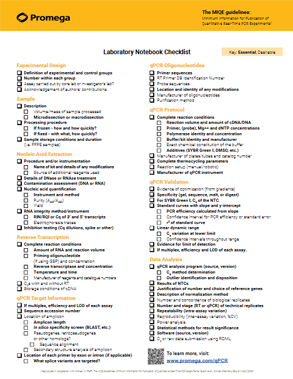
Download the MIQE Guidelines Checklist



Download the PCR and Real-Time PCR Brochure



What is Real-Time qPCR?
Real-time quantitative PCR, or qPCR, is a standard method for detecting and quantifying a specific target sequence, or quantifying gene expression levels in a sample. In qPCR, fluorescently labeled probes or nucleic acids, or fluorescent double-stranded DNA-binding dyes are incorporated into the PCR reaction and product formation is monitored in real time following each PCR cycle.
Probe-based qPCR uses a fluorescent primer or probe to detect the amplification product. An advantage of this method is that it allows sequence-specific detection of the target and reduces the likelihood of detecting nonspecific artifacts. Probe-based detection also can accommodate multiplex amplification by using differentially labeled probes. There are several different approaches to probe-based qPCR detection including hydrolysis probes such as TaqMan®, hybridization probes, hairpin probes and labeled primers.
The use of fluorescent DNA-binding dyes, like BRYT® Green or SYBR® Green, is one of the most straightforward qPCR approaches. A dye is added to the reaction, and fluorescence is measured at each PCR cycle. Because fluorescence of these dyes increases dramatically in the presence of double-stranded DNA, DNA synthesis can be monitored as an increase in fluorescent signal.
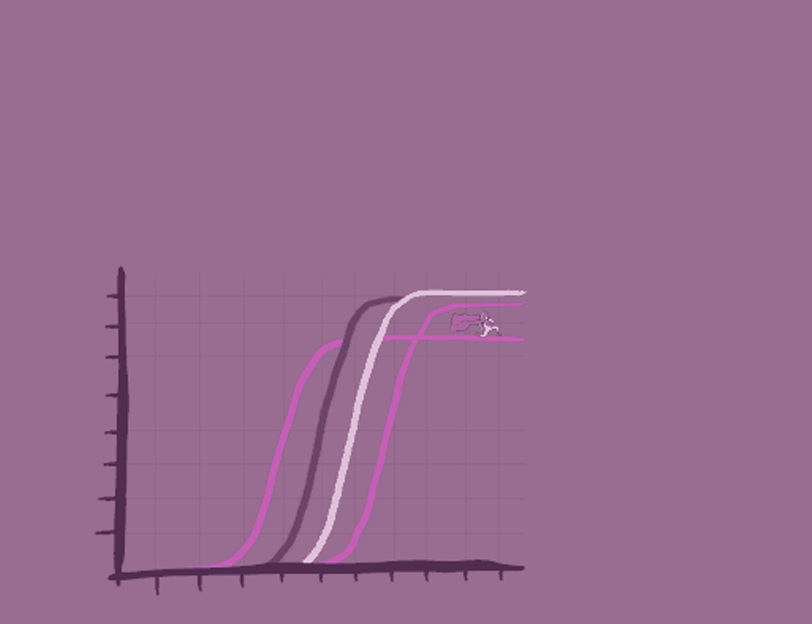
The primary output from a real-time PCR experiment is an amplification curve showing the accumulation of amplified product as fluorescent signal versus the cycle number.
Quantifying the amount of starting material is done using the quantification cycle (Cq, also known as Ct). Cq or Ct (threshold cycle) is the amplification cycle at which the fluorescence signal detected reaches an amplification threshold in a specific well. The amplification threshold is calculated based on the background fluorescence over the baseline region of all the curves in the group and represents the point where the reporter signal is significantly higher than the background levels. Cq is inversely related to the amount of starting template in the reaction and is a relative measure of the concentration of target in the PCR reaction.